

全国客服热线:
198-5307-5821
198-5307-5821
定义: 用于将化学能转化为电能的电池,这种电池使用海绵铅和二氧化铅,被称为铅酸电池。铅酸电池在发电厂和变电站中最常使用,因为它具有较高的电池电压和较低的成本。
铅酸电池的各个部件如下所示。容器和极板是铅酸电池的主要部分。容器储存化学能,极板将其转化为电能。
1. 容器 – 铅酸电池的容器由玻璃、铅衬木、乌木、含沥青的硬橡胶、陶瓷材料或模制塑料制成,并且位于顶部以避免电解液的泄漏。容器底部有四根肋骨,其中两根支撑正极板,另外两根支撑负极板。
棱镜作为板的支撑,并同时防止短路。电池箱的材料应耐硫酸,不得变形、多孔或含有损坏电解液的杂质。
2. 极板 – 铅酸电池的极板设计多样,均由铅和活性材料制成的格栅组成。格栅对于传导 电流 和均匀分配电流到活性材料上是至关重要的。如果电流分布不均,活性材料将会松动并脱落。
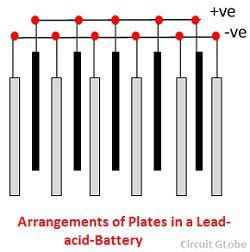 这些格栅是由铅和锑的合金制成的。它们通常由垂直于交叉位置或成对角线的横向肋条组成。正负极板的格栅设计相同,但负极板的格栅做得更轻,因为它们对电流的均匀传导不是那么重要。
电池的板片有两种类型。它们是形板或普兰特板和膏板或福尔板。
普朗特的板广泛用于固定电池,因为这些板比过去的粘贴板更重且更昂贵。但是,这些板更耐用,不太容易因快速充电和放电而失去活性材料。普朗特的板具有较低的容量重量比。
Faure process is much suitable for manufacturing of negative plates rather than positive plates. The negative active material is quite tough, and it undergoes a comparatively low change from charging and discharging.
3. Active Material – The material in a cell which takes active participation in a chemical reaction (absorption or evolution of electrical energy) during charging or discharging is called the active material of the cell. The active elements of the lead acid are
The lead peroxide and sponge lead, which form the negative and positive active materials have the little mechanical strength and therefore can be used alone.
4. Separators – The separators are thin sheets of non-conducting material made up of chemically treated leadwood, porous rubbers, or mats of glass fibre and are placed between the positive and negative to insulate them from each other. Separators are grooved vertically on one side and are smooth on the other side.
5. Battery Terminals – A battery has two terminals the positive and the negative. The positive terminal with a diameter of 17.5 mm at the top is slightly larger than the negative terminal which is 16 mm in diameter.
When the sulfuric acid dissolves, its molecules break up into positive hydrogen ions (2H+) and sulphate negative ions (SO4—) and move freely. If the two electrodes are immersed in solutions and connected to DC supply then the hydrogen ions being positively charged and moved towards the electrodes and connected to the negative terminal of the supply. The SO4— ions being negatively charged moved towards the electrodes connected to the positive terminal of the supply main (i.e., anode).
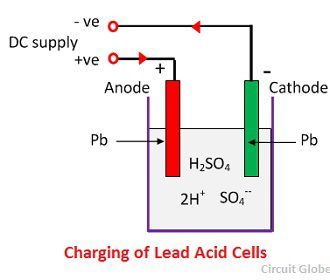 Each hydrogen ion takes one electron from the cathode, and each sulphates ions takes the two negative ions from the anodes and react with water and form sulfuric and hydrogen acid.
The oxygen, which produced from the above equation react with lead oxide and form lead peroxide (PbO2.) Thus, during charging the lead cathode remain as lead, but lead anode gets converted into lead peroxide, chocolate in colour.
If the DC source of supply is disconnected and if the voltmeter connects between the electrodes, it will show the potential difference between them. If wire connects the electrodes, then current will flow from the positive plate to the negative plate through external circuit i.e. the cell is capable of supplying electrical energy.
When the cell is full discharge, then the anode is of lead peroxide (PbO2) and a cathode is of metallic sponge lead (Pb). When the electrodes are connected through a resistance, the cell discharge and electrons flow in a direction opposite to that during charging.
The hydrogen ions move to the anode and reaching the anodes receive one electron from the anode and become hydrogen atom. The hydrogen atom comes in contacts with a PbO2, so it attacks and forms lead sulphate (PbSO4), whitish in colour and water according to the chemical equation.
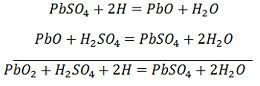
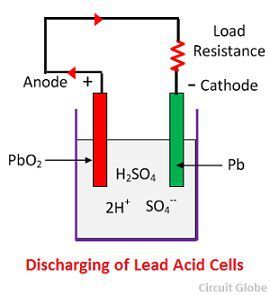 The each sulphate ion (SO4—) moves towards the cathode and reaching there gives up two electrons becomes radical SO4, attack the metallic lead cathode and form lead sulphate whitish in colour according to the chemical equation.
For recharging, the anode and cathode are connected to the positive and the negative terminal of the DC supply mains. The molecules of the sulfuric acid break up into ions of 2H+ and SO4—. The hydrogen ions being positively charged moved towards the cathodes and receive two electrons from there and form a hydrogen atom. The hydrogen atom reacts with lead sulphate cathode forming lead and sulfuric acid according to the chemical equation.

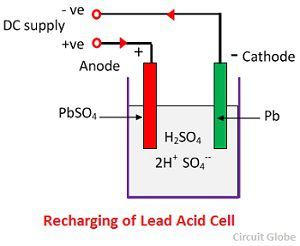 SO4— ion moves to the anode, gives up its two additional electrons becomes radical SO4, react with the lead sulphate anode and form leads peroxide and lead sulphuric acid according to the chemical equation.
 The charging and discharging are represented by a single reversible equation given below.
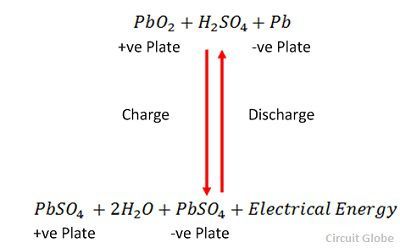 The equation should read downward for discharge and upward for recharge.
联系人:于经理
手 机:198-5307-5821
邮 箱:batteryltd@sina.com